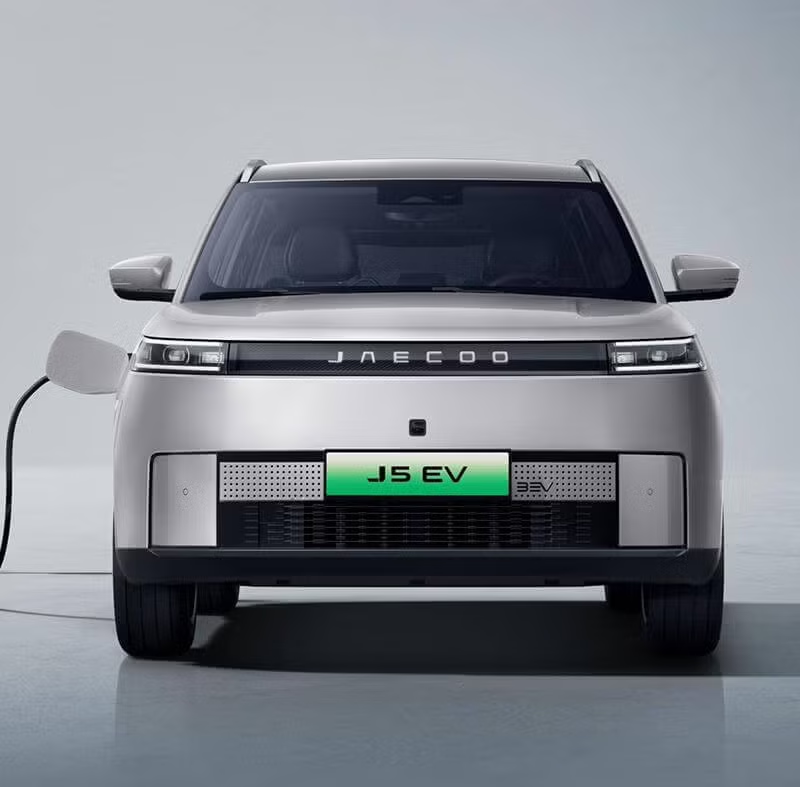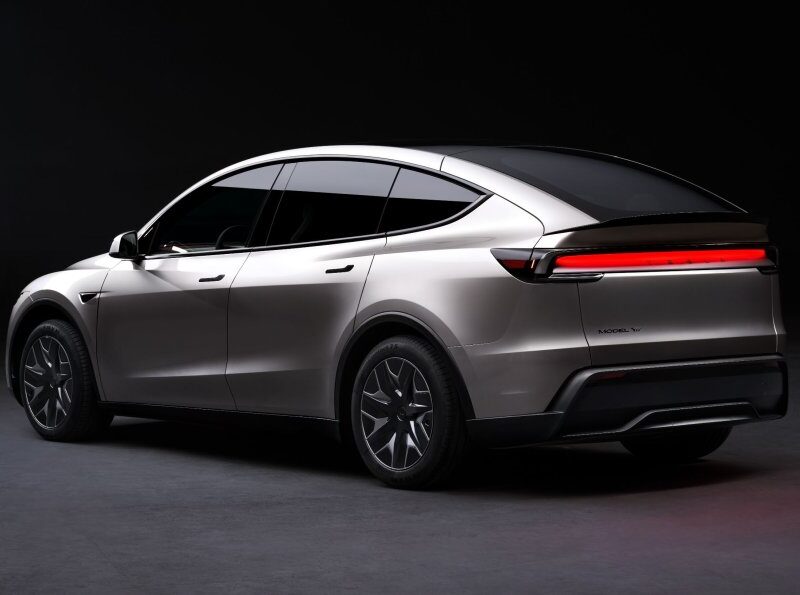


The automotive landscape has shifted. For the first time in history, Battery Electric Vehicles (BEVs) have overtaken traditional petrol vehicle sales in the European Union. As we move into early 2026, the data paints a clear picture: the “electric revolution” is no longer a forecast—it is the current reality for the world’s leading economies.
The Global Surge: January 2026 Snapshot
While much of the world has hit the accelerator, the contrast between European adoption and the Australian market is stark.
RegionBEV Market Share (Jan 2026)Growth vs. Jan 2025France28.4%+11.0%Germany22.0%+23.8%United Kingdom20.6%+4.1%Europe (Total)22.0% (Full Year 2025)+30.0% (Sales Volume)Australia8.4%+0.1%In Australia, our adoption has essentially plateaued, hovering around the 8.3% – 8.4% mark. We are now lagging behind not just established Western powers, but many developing nations that are aggressively pursuing fuel security and environmental benefits through BEV technology.
Debunking the Distance Myth
The most common argument against EVs in Australia is our vast geography. However, the data suggests that for the vast majority of Australians, the “tyranny of distance” is a psychological barrier, not a practical one.
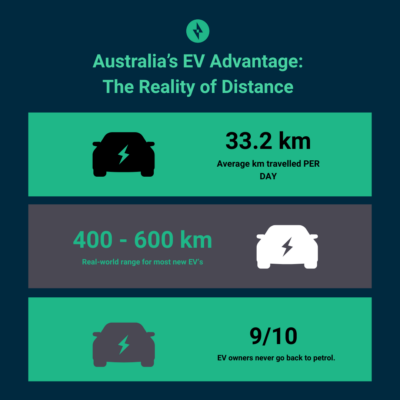
The Daily Reality: The average Australian vehicle travels just 33.2 km per day.
The Commute: Even with growing travel times, the average daily commute is 37 km. Even regional drivers, who typically travel further, average only 38–45 km per day.
The Capability: Modern BEVs, like the Hyundai Ioniq 6, now frequently offer real-world ranges between 400 km and 600 km.
The 90% Rule: For 90% of the population who drive less than 50 km a day, a BEV isn’t just “suitable”—it’s a superior experience.
Why Owners Aren’t Looking Back
There is a reason why 9 out of 10 EV owners swear they will never return to a petrol car. Recent 2025/2026 surveys show owner satisfaction scores hitting 90/100, driven by lower running costs, instant torque, and the “refill at home” convenience.
The Hyundai Ioniq 6 has become the poster child for this shift, frequently cited for the highest “satisfaction-to-price” ratio. Its radical “Electrified Streamliner” aerodynamics don’t just look futuristic; they enable world-class efficiency and ultra-fast charging (10% to 80% in just 18 minutes).

The Policy Crossroads: Now is Not the Time to Brake
The Australian government’s FBT-exemption has been a vital catalyst, helping nearly 100,000 Australians transition to electric. However, with this policy currently under review in early 2026, the industry is at a critical juncture.
To bridge the gap with Europe, we must not only maintain current stimuli but expand them. This includes:
Protecting the FBT-Exemption: Ensuring BEVs remain accessible for fleet and salary-packaged buyers.
Vehicle-to-Grid (V2G) Benefits: Incentivizing owners to use their cars as “batteries on wheels” to support the national grid.
Infrastructure for All: Continuing the rapid rollout of chargers for apartment dwellers and those without off-street parking.
The Bottom Line
Australia has the renewable resources and the urban driving patterns to be a world leader in electric mobility. The only thing holding us back is a lingering lack of faith in a technology that has already proven itself across the globe.
If you’re still unsure, don’t look at the brochures; ask a BEV owner. You’ll likely find an honest, overwhelmingly positive answer from someone who has already discovered that the future of driving is silent, sustainable, and already here.